Ladakh Red Sky Phenomenon: What Caused the Stunning Glow 2026
Ladakh Red Sky Phenomenon: What Caused the Stunning Glow in January 2026
Ladakh Red Sky Phenomenon:
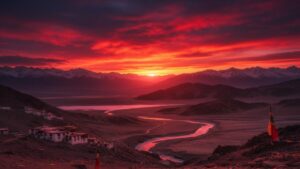
Research suggests the red sky in Ladakh was a rare aurora from a powerful solar storm, visible farther south than usual due to intense geomagnetic activity. It seems likely that such events warn of potential disruptions to technology like satellites and power grids, though the beauty captivates observers. Evidence leans toward this being the strongest radiation storm since 2003, highlighting the Sun’s active cycle. The approach acknowledges the spectacle’s dual nature as both a natural wonder and a sign of space weather risks, with debates on how prepared societies are.
– The red sky in Ladakh was likely a red aurora from a solar storm, not pollution or supernatural causes.
– It happened on January 19-20, 2026, at Hanle Dark Sky Reserve, due to high-energy particles from the Sun.
– Such events can disrupt communications, but this one mainly offered a beautiful sight.
– For USA viewers, similar auroras might appear during strong storms, visible in northern states.
– Always check space weather forecasts to stay safe and informed.
What Happened
On January 19 and 20, 2026, the sky over Hanle in Ladakh turned a deep red, creating a breathtaking view. This was no ordinary sunset but a rare red aurora, caused by a powerful solar storm hitting Earth. People shared photos online, comparing them to northern lights, though it’s unusual so far south.
Scientific Explanation
The red glow came from oxygen atoms high in the atmosphere excited by solar particles. A coronal mass ejection from an X1.9 solar flare on January 18 triggered it, leading to a G4 geomagnetic storm. At over 300 km altitude, this produced red light instead of green.
Implications
While pretty, it signals risks like satellite damage or power outages. The S4 radiation storm, the strongest since 2003, shows the Sun’s peak activity in its 11-year cycle. For the USA, similar storms could affect northern areas, but early warnings help mitigate issues.
Viewing Tips
Dark skies like Hanle’s reserve enhance visibility. Use apps for space weather alerts. In the USA, head to places like Alaska for auroras.
—
The red sky over Ladakh in January 2026 captured attention worldwide, blending beauty with a subtle warning from nature. This long exploration dives into the event’s details, science, history, global context, and lessons for USA observers. We’ll cover causes, effects, similar occurrences, and how to prepare, using simple terms so anyone can learn.
Event Details
Hanle, in eastern Ladakh, India, is home to the Indian Astronomical Observatory and a dark sky reserve, perfect for stargazing. On the nights of January 19 and 20, 2026, the sky glowed blood-red for hours, surprising locals and scientists. Photos showed a crimson hue over mountains, reflected in waters, looking like a scene from a movie. The Department of Science and Technology, India, shared images, noting it as a rare aurora. Unlike typical green auroras, this red one was visible at lower latitudes due to the storm’s strength.
Social media buzzed with reactions—some called it magical, others worried about omens. But experts explained it as space weather, not a mystery. The event lasted through the night, fading by dawn. Hanle’s high altitude (4,500 meters) and low light pollution made it ideal for observation. ISRO’s Aditya-L1 satellite at the L1 point detected the incoming storm, giving advance notice.
The Science Behind It
Auroras happen when solar particles collide with Earth’s atmosphere. The Sun ejects plasma in coronal mass ejections (CMEs), travelling millions of kilometres. On January 18, 2026, an X1.9 flare from Active Region 14341 sent a CME at 1,700 km/s, reaching Earth in 25 hours. This caused a G4 geomagnetic storm, compressing Earth’s magnetic field.
Particles excite gases: Nitrogen for blue/purple, oxygen for green/red. Red auroras occur at high altitudes (300+ km) when oxygen atoms emit light at 630 nm wavelength. The S4 radiation storm involved high-energy protons, making the display visible in Ladakh (34°N latitude), far from the poles.
The Sun’s 11-year cycle is at maximum in 2026, increasing flares. This was the strongest since 2003, per NASA.
| Term | Explanation | Role in Event |
|——|————-|—————|
| Solar Flare | Sudden energy release on Sun | Triggered CME |
| CME | Cloud of plasma/magnetic field | Hit Earth, caused storm |
| Geomagnetic Storm | Disturbance in Earth’s magnetosphere | Enabled aurora south |
| Radiation Storm | High-energy particles | S4 level, rare intensity |
| Aurora | Atmospheric glow | Red from high-altitude oxygen |
Historical Context
Auroras have been recorded for centuries—ancient texts describe “blood rains” in the skies. In India, similar red auroras occurred in 1872 during the Carrington Event, causing telegraph disruptions. The 2003 storm affected satellites worldwide. Ladakh’s 2026 event echoes these, but modern tech provides better monitoring.
In the USA, the 1989 Quebec blackout from a storm shows risks. Recent 2024 events in northern USA saw pink auroras, but 2026’s intensity pushed visibility south.
Global Implications
Solar storms can disrupt GPS, radios, and power grids by inducing currents. The 2026 storm risked blackouts and satellite failures, but warnings helped. For airlines, radiation posed flight risks. In the USA, NOAA’s Space Weather Prediction Centre issued alerts, protecting infrastructure.
Positive side: Boosts tourism—people flock to dark skies for auroras. But it highlights climate links, as stronger storms are tied to solar activity.
Similar Events
In May 2024, a red aurora appeared in Ladakh from a G5 storm, the strongest since 2003. The USA saw widespread auroras then, from Washington to Florida. The 2026 event was S4, slightly less but still rare. Northern lights are common in Alaska and Canada, but red ones signal extreme activity.
Viewing and Safety
To see auroras, go to dark areas away from lights. Apps like My Aurora Forecast predict based on the Kp index (5+ for visibility). In the USA, northern states like Minnesota or Michigan are best during storms. Use cameras for better capture, as the eyes see less colour at night.
Safety: Avoid high-radiation times for flights. Check NOAA for updates. Personal advice: If planning a trip, combine with stargazing—it’s rewarding but pack warm!
Lessons for the USA
The USA invests in space weather via NASA and NOAA, with satellites like GOES monitoring. Events like Ladakh’s remind us of vulnerabilities—power companies harden grids. Students can learn via apps or observatories.
Future: As the solar maximum continues, more auroras are expected through 2027.
For more, visit [NOAA Space Weather](https://www.swpc.noaa.gov/) or [NASA Solar Flare Info](https://science.nasa.gov/missions/heliophysics/solar-flares). Call to action: Download a space weather app today and watch the skies—nature’s shows are free!